Le piège
Confiant, fluide et faux
Chaque jour, vous rencontrez des sources qui semblent parfaitement sûres d'elles-mêmes : un site web soigné, une vidéo populaire, un ami qui ne fait jamais de réserve, une application de shopping, un outil d'aide aux études, un suivi de santé. Ils fournissent des réponses rapidement, en phrases claires, avec zéro doute visible.
Voici la vérité inconfortable sur laquelle repose cette leçon : la confiance n'est pas une preuve. Une source peut affirmer quelque chose avec une certitude totale et être quand même totalement fausse. Le polish d'une réponse ne vous dit rien sur le fait qu'elle est vraie.
Alors, comment sait-on réellement quelque chose ? Non pas en se sentant sûr, et non pas en faisant confiance à celui qui semble le plus sûr. On sait en raisonnant avec soin et en vérifiant les affirmations par rapport à des preuves indépendantes. Cette compétence a quatre parties, et vous allez construire chacune d'elles aujourd'hui :
1. Taux de base : pourquoi un test très précis pour un événement rare produit quand même majoritairement de fausses alertes.
2. Corrélation vs causalité : pourquoi le fait que deux choses évoluent ensemble ne signifie pas que l'une cause l'autre.
3. Biais de confirmation : pourquoi nous faisons excessivement confiance aux réponses qui correspondent à ce que nous croyons déjà.
4. Vérification : comment trianguler une affirmation en la confrontant à des sources indépendantes avant d'agir en conséquence.
Échauffement
Avant de commencer, une brève réflexion. Se tromper tout en étant certain n'est pas rare : c'est la condition humaine normale. Nommer un moment où cela vous est arrivé rendra le reste de cette leçon plus mémorable.
Le test de la maladie rare
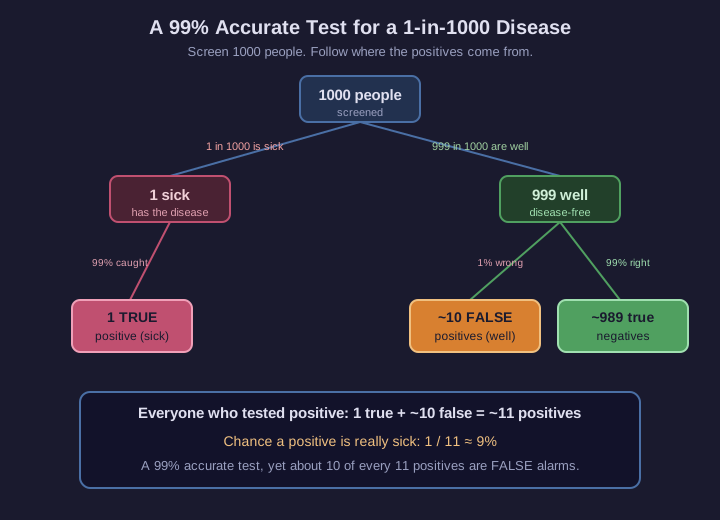
Pourquoi les tests précis nous trompent encore
Un taux de base est la fréquence avec laquelle quelque chose est courant avant de réaliser un quelconque test. L'ignorer est l'une des erreurs de raisonnement les plus coûteuses qui soient : et presque tout le monde la commet.
Voici le scénario. Lisez-le attentivement ; vous calculerez la réponse à l'écran suivant.
- Une maladie touche 1 personne sur 1000 (c'est le taux de base).
- Il existe un test qui est 99 % précis : si vous êtes malade, il indique positif 99 % du temps, et si vous êtes en bonne santé, il indique négatif 99 % du temps (il se trompe donc sur 1 % des personnes en bonne santé).
- Vous passez le test. Le résultat est positif.
L'intuition de presque tout le monde dit : 99 % de précision, donc j'ai environ 99 % de chances d'être malade. Gardez cette idée en tête. Nous allons la vérifier par rapport au taux de base au lieu de faire confiance à l'intuition.
La méthode : imaginez 1000 personnes et comptez.
- Sur 1000 personnes, environ 1 est réellement malade. Le test détecte cette personne : appelons cela 1 vrai positif.
- Les 999 autres sont en bonne santé. Le test se trompe sur 1 % d'entre eux : 999 x 0,01, c'est environ 10 faux positifs.
Donc, parmi toutes les personnes dont le test est positif, il y a environ 1 vrai positif et environ 10 faux positifs.
Faites le compte
Votre calcul
Utilisez les compteurs de l'arbre : environ 1 vrai positif, environ 10 faux positifs.
Ce que le nombre enseigne
L'essentiel
L'habitude la plus importante de cette section : quand quelque chose est rare, même un test très précis produit principalement des faux positifs. Le taux de base peut écraser la précision.
Il ne s'agit pas seulement de tests médicaux. Cela concerne les alertes de fraude, les filtres anti-spam, les scanners de sécurité et tout système confiant qui signale un événement rare. Un « positif » provenant d'un tel système est une raison de regarder de plus près, pas un verdict. Plus l'événement est rare, plus une seule alerte devrait déclencher une vérification plutôt qu'une croyance.
Quand deux choses évoluent ensemble
Corrélation vs Causalité
Deux éléments sont corrélés lorsqu'ils évoluent ensemble : lorsque l'un augmente, l'autre a tendance à faire de même. Il est tentant de conclure que l'un cause l'autre. Cette conclusion est généralement infondée. Il existe au moins trois explications innocentes pour toute corrélation :
1. Facteur de confusion (une troisième cause latente). Les ventes de glaces et les noyades augmentent ensemble. La glace ne cause pas les noyades ; la chaleur est à l'origine des deux. Le facteur de confusion est le véritable moteur.
2. Causalité inversée. Les personnes qui utilisent une application de fitness sont en meilleure santé, donc l'application doit-elle causer la santé ? Peut-être que ce sont les personnes déjà en bonne santé qui choisissent l'application. La flèche peut pointer dans l'autre sens.
3. Coïncidence. Avec suffisamment de variables mesurées, certaines s'aligneront par pur hasard, sans aucun lien réel.
La démarche professionnelle : avant d'accepter « X cause Y », demandez-vous que d'autre pourrait expliquer cela ? Une source qui se veut confiante mais qui saute cette question vous vend une histoire, pas une découverte.
Trouver la cause cachée
À vous de jouer
Une étude rapporte : « Les élèves qui possèdent plus de livres obtiennent de meilleurs scores aux tests de lecture. Par conséquent, acheter plus de livres augmente les scores aux tests. » Une application de shopping en cite même les résultats pour vendre des lots de livres aux parents, avec beaucoup d'assurance.
Croire ce qui s'adapte
Le biais qui nourrit vos croyances
Le biais de confirmation est la tendance à remarquer, croire et retenir les preuves qui correspondent à ce que nous pensons déjà, tout en ignorant ou en minimisant les preuves qui ne le font pas. Il agit silencieusement en arrière-plan de presque tous nos jugements.
Les outils modernes aggravent les choses. Les résultats de recherche, les flux et les systèmes de recommandation apprennent ce que vous aimez et vous en proposent davantage. Posez une question orientée et vous obtenez souvent une réponse confiante, formulée pour être d'accord avec vous. Le résultat donne l'impression d'une confirmation indépendante, mais c'est un écho : la même croyance renvoyée, déguisée en preuve.
L'antidote est délibéré : cherchez activement les preuves les plus fortes qui montrent que vous avez tort. Si vous n'en trouvez aucune, ou si vous les rejetez trop vite, c'est le biais qui parle.
Détecter le biais
À votre tour
Maya est convaincue qu'un certain complément alimentaire a guéri son rhume. Elle se souvient des moments où elle l'a pris et s'est rétablie, raconte ces histoires et oublie les moments où il n'a rien fait. Quand une amie mentionne une étude montrant qu'il n'est pas efficace, elle dit que l'étude « doit être biaisée » et passe à autre chose. Elle demande également à une application de santé très sûre d'elle-même : « Est-ce que ce complément est bon pour les rhumes ? » et celle-ci répond avec enthousiasme que oui.
Vérification indépendante
L'habitude qui relie tout
Chaque outil présenté jusqu'ici pointe vers une même compétence : ne pas faire confiance à une affirmation catégorique ; la vérifier. La méthode la plus fiable est la triangulation : vérifier une affirmation en la confrontant à deux ou plusieurs sources indépendantes avant d'agir en conséquence.
Le mot indépendante fait tout le travail. Trois sites qui ont tous copié le même communiqué de presse ne sont pas trois sources : c'est une seule source, écho trois fois. Une vraie triangulation nécessite des sources qui pourraient être en désaccord, mais qui ne le sont pas.
Une liste de contrôle pratique avant d'agir sur toute affirmation à fort enjeu :
- Indépendance : Mes sources remontent-elles à la même origine, ou ont-elles été collectées séparément ?
- Taux de base : À quel point cela est-il vraiment courant ? Une alerte catégorique pourrait-elle être majoritairement un faux positif ?
- Cause : Une histoire causale est-elle vendue à partir de ce qui n'est qu'une corrélation ?
- Mon propre biais : Est-ce que j'y crois en partie parce que je voulais déjà que ce soit vrai ?
- Enjeux : Plus la décision est importante (santé, argent, sécurité), plus elle mérite une confirmation indépendante.
Vérifier une affirmation réelle
À votre tour
Une application d'aide aux études vous indique, avec une grande assurance et dans un style fluide, qu'une date historique est 1847 et qu'une formule fonctionne d'une certaine manière. Vous avez un examen demain et la réponse est importante.
Ce que vous emportez
Une dernière réflexion
Vous disposez désormais de quatre outils contre l'erreur confiante : vérifier le taux de base avant de faire confiance à une alerte sur un événement rare, séparer la corrélation de la causalité, surveiller le biais de confirmation chez vous-même et dans vos outils, et trianguler à partir de sources indépendantes avant d'agir.
Aucun de ces outils ne nécessite d'être un génie. Ils exigent une seule habitude : traiter la confiance : la vôtre ou celle d'une source éloquente : comme une question à tester, et non comme une réponse à accepter.
Ceux qui sont le moins trompés ne sont pas ceux qui se sentent les plus sûrs. Ce sont ceux qui vérifient.