Welcome
Welcome! Today we are going to be chance detectives.
Every day, things happen that we cannot know for sure. Will it rain? Which line at the store moves faster? Is the milk still good to drink?
We cannot always know for sure, but we can make a smart guess about how likely something is. That is what good thinkers do.
Let's get started!
Likely, Maybe, and Unlikely
Three Chance Words
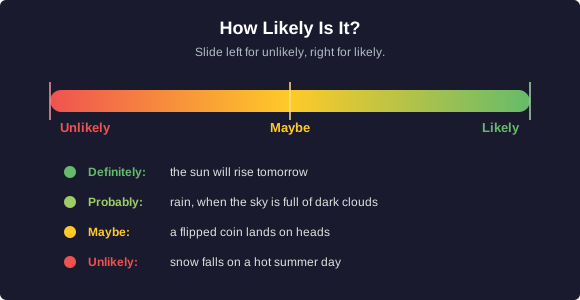
Here are three words that tell how likely something is:
- Likely means it will probably happen. Example: the sun will come up tomorrow morning.
- Maybe means it could go either way. Example: a flipped coin lands on heads. It could, or it could not.
- Unlikely means it will probably NOT happen. Example: snow falls on a hot summer day.
We can also say probably (pretty sure it will happen) and definitely (sure for certain).
Think of a slider that goes from unlikely on one side to likely on the other. Most things sit somewhere in the middle at maybe.
Your Turn - Likely or Unlikely?
Your Turn
Here is a chance to sort something yourself.
Clues Help You Judge
Reading the Clues
Good chance detectives look for clues. A clue is anything you notice that helps you guess.
Think about the question: will it rain today?
- If the sky is bright blue with no clouds, that is a clue that rain is unlikely.
- If the sky is full of dark, heavy clouds, that is a clue that rain is likely.
The more clues point the same way, the surer you can be. One dark cloud means maybe. A whole sky of dark clouds means probably.
Clues turn a wild guess into a smart guess.
Your Turn - Read the Clue
Your Turn
Here is the situation: you look outside and the sky is full of dark, heavy clouds, and the wind is picking up.
Picking the Better Chance
Choosing When You Are Not Sure
Sometimes you have to pick, even though you cannot know for sure what will happen. A good thinker picks the choice with the better chance of a good result.
Imagine you are at a store with two checkout lines:
- Line A has 2 people, each with a small basket.
- Line B has 6 people, each with a full, overflowing cart.
You cannot know for sure which line is faster. But Line A has fewer people and less to scan, so Line A is more likely to be faster. That makes it the better choice.
Making a good choice does not mean you will always be right. It means you picked the option that was most likely to work out well.
Your Turn - Pick the Better Chance
Your Turn
Here is a choice: you want to stay dry on your walk to school. The sky is full of dark rain clouds. You can bring an umbrella, or leave it at home.
New Information Can Change Your Guess
When New Clues Arrive
The best chance detectives are willing to change their mind when they get new information. That is not being wrong. That is being smart.
Imagine you smell the milk to check if it is still good:
- At first you think, "This milk is probably fine, I bought it a few days ago."
- Then you take a sniff, and it smells sour. That is new information!
The sour smell is a new clue. A smart thinker updates their guess: "I changed my mind. This milk is probably spoiled, so I will not drink it."
Changing your guess when a new clue shows up is one of the most grown-up things a thinker can do.
Your Turn - Would You Change Your Mind?
Your Turn
Here is the situation: you decided to leave your umbrella at home because the morning sky was clear and blue. At lunchtime, you look out the window and the sky has turned dark and cloudy.