Welcome
Fire is one of humanity's oldest tools and one of its biggest hazards. Today you learn to handle it both ways.
A skilled fire handler can start a fire from nothing, keep it going for hours, and leave a campsite with no trace it was there.
An unskilled fire handler starts forest fires, burns down tents, and lands people in the hospital.
By the end of this lesson, you will know how to be the first kind.
Warm-Up
Let's Start!
Before we learn the science and the rules, think about what you have seen.
Three Sides, Every Fire
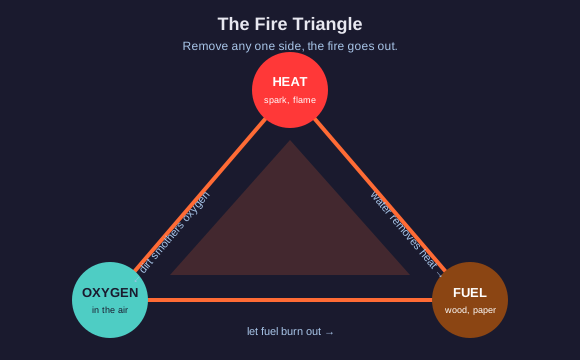
What Every Fire Needs
Every fire on Earth needs three things at the same time:
- Heat — a spark, a match flame, friction
- Fuel — anything that burns, like wood, paper, or grass
- Oxygen — the air we breathe (fire breathes it too)
We call this the fire triangle. All three sides have to be present for fire to exist.
Take away any one side and the fire goes out. That is the secret.
Want to put a fire out? You do not need to fight all three. You just need to remove one.
Apply the Triangle
Now you have a tool. Use it.
Small to Big: Tinder, Kindling, Fuel
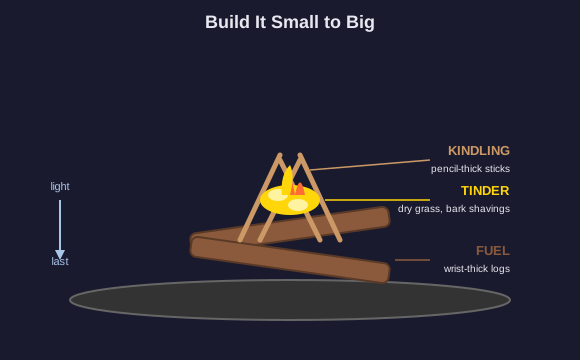
Three Stages of Fuel
A match flame is tiny. A log is huge. You cannot light a log with a match directly.
You have to build the heat up through three stages:
- Tinder — the smallest dry stuff: dry grass, bark shavings, pine needles, paper, fluffy fibers. Lights from a single spark.
- Kindling — pencil-thick dry sticks. Catches from tinder.
- Fuel — wrist-thick dry logs. Catches from kindling.
Smallest first. Largest last. Each stage hands its heat up to the next.
Skip a stage and your fire dies. Patience builds the bigger flame.
In What Order Do You Add Fuel?
You have all three sizes of wood ready beside you. You strike a match.
Site Discipline
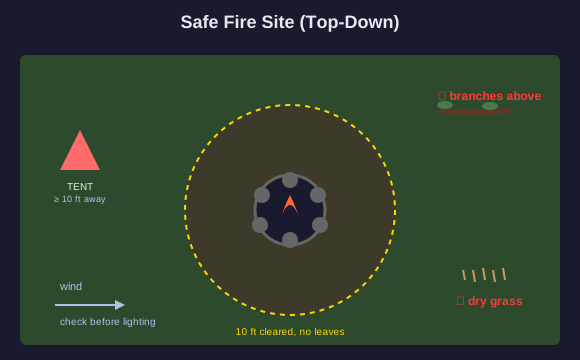
What a Safe Fire Site Looks Like
Most wildfires start from campfires that were built in the wrong spot.
A safe fire site has all of these:
- A cleared circle at least 10 feet across, no leaves, no twigs, no dry grass
- A fire ring of stones or a metal pit to contain the coals
- At least 10 feet from every tent, fuel can, and tree trunk
- No low branches above the fire (heat rises, branches catch)
- A bucket of water and a shovel within arm's reach before you light the match
- Wind check before lighting — strong wind means do not light at all
Find the Hazard
Now you know what a good site looks like. Flip the question around.
How to Know a Fire Is Really Out
The Three-Word Rule
Here is the saying every wildland firefighter knows by heart:
Drown. Stir. Feel.
1. Drown — pour plenty of water on the ashes. More than you think you need.
2. Stir — use a stick to mix the wet ashes. Buried coals can smolder for hours if you skip this step.
3. Feel — place the back of your hand near (not on) the ashes. If you feel ANY warmth, repeat the whole sequence.
Do not leave until the ashes feel cool to the touch. A buried coal can start a wildfire days later.
If you don't have enough water, smother the fire with dirt and mix it in. Cool to touch is the only finish line.
How Do You Know?
You poured water. The flames are gone. The fire ring looks calm.
Pick a Rule
One Rule to Carry
You learned the fire triangle, the build order, site discipline, and how to know a fire is out.
Each one of these rules has saved a forest somewhere.
Pick the one you will hold onto.