Welcome
Before phones, before GPS, before printed maps, people crossed continents using two tools: the sun and a compass.
Today you learn the same skills they used. These tools have one big advantage over a phone: they never run out of battery.
By the end of this lesson, you will be able to find north without any technology, read a topographic map, and stay calm when your tools disagree.
Let's begin.
Warm-Up
Let's Start!
Picture this: you are on a trail. You took a wrong turn. The trail ahead looks unfamiliar.
Your Free Compass: The Sun
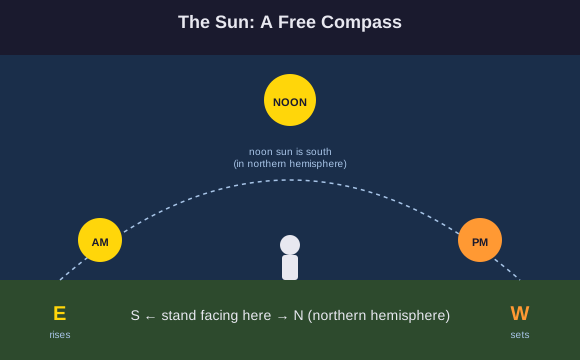
The Four Cardinal Directions
Every map and compass uses four basic directions: North (N), South (S), East (E), West (W).
Memory aid: Never Eat Soggy Waffles, going clockwise starting from the top.
Even without a compass, you have a free direction-finder in the sky every day.
The sun rises in the EAST and sets in the WEST. This is true everywhere on Earth, every day.
Stand facing the morning sun: east is in front, west is behind, north is to your left, south is to your right (in the northern hemisphere).
Use the Sun
You are lost in the morning and your phone is dead.
Parts of a Compass
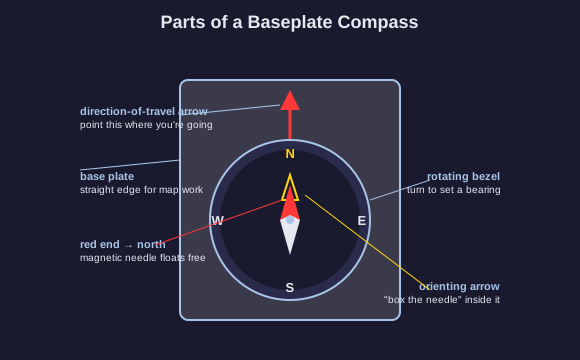
How a Compass Works
A magnetic compass has a needle that floats freely, always pointing to magnetic north.
The red end of the needle is always the north end.
A baseplate compass has these parts:
- Direction-of-travel arrow on the base — point this where you want to go
- Rotating bezel with N, E, S, W marked — turn this to set a bearing
- Orienting arrow inside the bezel — when you 'box the needle' inside this arrow, you are oriented
One small note: magnetic north and true north differ by an angle called declination, which a real topo map will list. For backyard use the difference is small.
What Does the Red End Point To?
Picture a baseplate compass flat in your hand. The needle settles.
Maps With Elevation
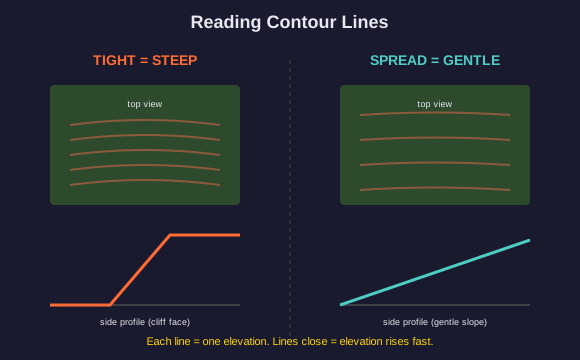
Topographic Maps
A topographic map (or topo map) shows not just where things are, but how high they are.
It uses contour lines — each line connects all points at the same elevation.
Picture slicing the land horizontally at every 20 feet of height. Each slice is one contour line.
The key insight: when the lines on the map are close together, the elevation is changing fast over a short distance. That means steep terrain, maybe a cliff.
When the lines are spread far apart, elevation changes slowly. That means gentle slope, easy walking.
A topo map also has:
- Legend — tells you what each symbol means
- Scale — how distance on the map maps to distance on the ground
- North arrow — orient the top of the map to north
What Do Tight Lines Mean?
You unfold your topo map. You see a spot where the contour lines are packed tightly together.
Trust But Verify
The Wilderness Rule
Real navigation rarely fails because the compass lies. It fails because someone trusted ONE reading and stopped checking.
Triangulate — use multiple sources. If the compass, the trail signs, and the landmarks all agree, you are oriented. If two of three agree, lean toward those two but stay alert.
Watch for compass interference. Metal belt buckles, phones, power lines, and rebar can all swing a magnetic needle. Step away and re-check.
STOP is the wilderness rule for lost: Stop, Think, Observe, Plan. Walking faster usually makes lost worse.
When in doubt: sit down, drink water, eat a snack, look at the map, and ask yourself what you actually know for sure.
Compass vs Trail Sign
You are hiking. Your compass says north is one way. A trail sign points the opposite direction.
One Skill, This Week
Pick a Skill
Knowing a skill is one thing. Practicing it is what makes it stick.
Pick one navigation skill you want to practice this week — in your yard, on a trail, or just looking at a paper map.