Welcome
For most of human history, the night sky was the only map sailors and travelers had. It worked.
Today you learn the same two skills: how to find north using the Big Dipper, and what really causes the seasons (it is NOT distance from the sun).
These tools work anywhere on a clear night in the northern hemisphere. They have for ten thousand years. They still will tomorrow.
Let's look up.
Warm-Up
Let's Start!
Almost everyone has noticed something in the night sky at some point.
The Big Dipper's Trick
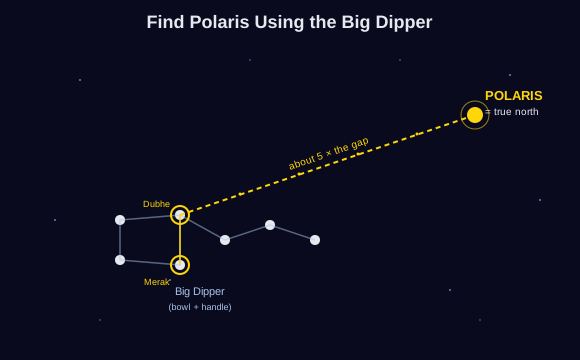
The Big Dipper Points the Way
Polaris, the North Star, is the one star in the sky that does not appear to move. Everything else rotates around it. That makes it a perfect compass.
But Polaris is NOT the brightest star. This is the most common myth. It's a moderately bright star — easy to miss in city skies.
Here is the trick navigators have used for centuries:
1. Find the Big Dipper — bowl plus handle, easy to spot.
2. Look at the two outer stars of the bowl (the side opposite the handle). These are called the pointer stars: Dubhe and Merak.
3. Draw an imaginary line from Merak through Dubhe, and extend it about 5 times the gap between them.
4. That line lands on Polaris.
Polaris is also the tip of the Little Dipper's handle, if you want to double-check.
Describe the Trick
Picture the night sky. You spot the Big Dipper. Now talk through how you find Polaris.
Why Polaris Doesn't Move
A Star Above the North Pole
Polaris sits almost directly above the Earth's North Pole. As Earth spins on its axis, all the other stars appear to wheel around the sky — but Polaris just hangs there.
Stand facing Polaris and you are facing true north. No compass needed.
This is slightly different from magnetic north (what your compass needle finds). True north and magnetic north differ by an angle called declination, which varies by location.
Sailors used this for thousands of years. The sky did not need batteries.
What Direction Does Polaris Point?
Imagine you have just found Polaris in the sky.
Axial Tilt: The Real Reason
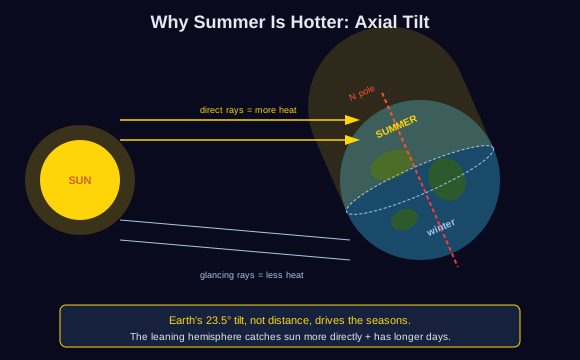
The Famous Wrong Answer
Most adults will tell you summer is hotter because Earth is closer to the sun in summer. This is wrong.
In fact, Earth is slightly FARTHER from the sun during northern hemisphere summer than during winter. The distance barely matters.
The real cause is the Earth's axial tilt — about 23.5 degrees.
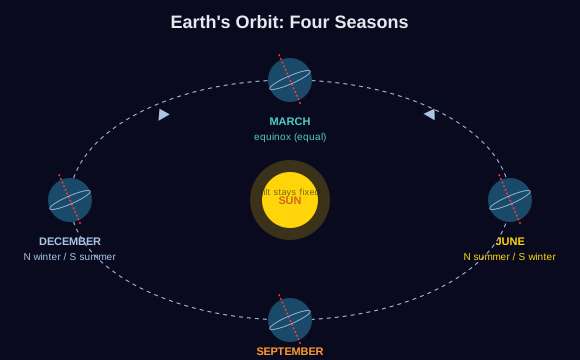
What Actually Happens
Earth's spin axis stays tilted in the same direction all year long. As Earth orbits the sun:
- When your hemisphere tilts TOWARD the sun, sunlight hits the ground more directly. The day is also longer. That's summer.
- When your hemisphere tilts AWAY, sunlight comes in at a glancing angle. The day is shorter. That's winter.
Direct light + long days = summer. Glancing light + short days = winter. The other hemisphere experiences the opposite at the same time.
Explain the Seasons
Now you know the real cause.
This Month's Sky
Knowledge + Practice = Mastery
Find a clear night sometime soon. Even a backyard is enough.
Knowing this stuff is one thing. Pointing at the actual sky and naming what you see is what makes it real.