Welcome
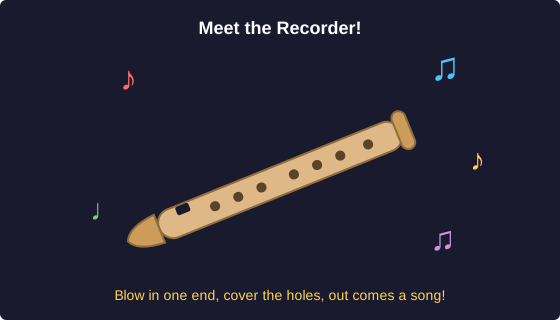
Hi there, little musician! Welcome!
Today we will get ready to play a special instrument: the recorder. It is a little wooden or plastic flute. You blow into one end, you cover the holes with your fingers, and out comes a song!
Soon you will play real songs on it. Today we get ready, and we have a lot of fun.
Sounds Go Up and Down
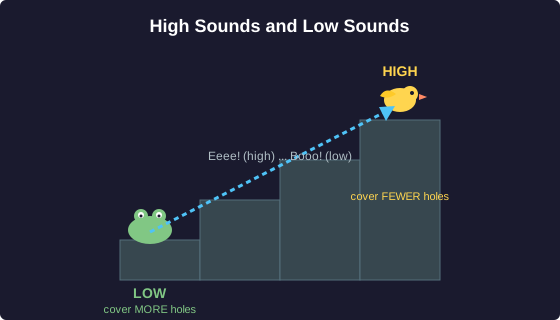
Some sounds are high, like a tiny bird or a little squeak. Eeee!
Some sounds are low, like a big dog or a deep drum. Booo!
On a recorder, when you cover up more holes with your fingers, the sound gets lower. When you take fingers off, the sound gets higher. Up and down, like going up and down stairs!
Try it with your voice: make a high little sound, then a low big sound.
Sounds Can Be Loud or Soft
Music can be loud, like a marching band: TA-DA!
Music can be soft, like a little lullaby: shhh, hush now.
Here is a music secret about the recorder: you blow gently into it, like you are warming up your cold hands. Haaaa. Soft, warm air. If you blow too hard, the recorder squeaks like a tiny mouse! So we always blow gently.
Try it now: hold up your hands like they are cold, and blow gentle warm air on them. Haaa. That is exactly how you blow into a recorder.
Music Has a Heartbeat
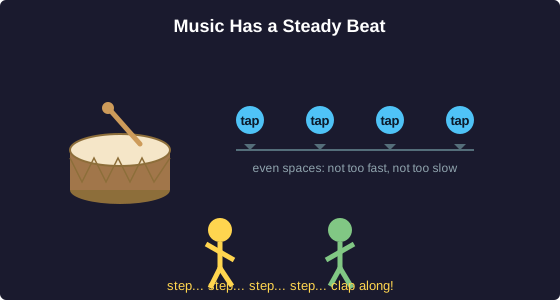
Music has a beat, like a heartbeat. Tap, tap, tap, tap. Steady and even, not too fast and not too slow.
Clap your hands slowly and steadily: clap... clap... clap... clap. That is a beat!
When you play the recorder, you keep the beat going while you play the notes. Marching helps: step, step, step, step. Try marching in place and clapping at the same time.
Fingers Cover the Holes
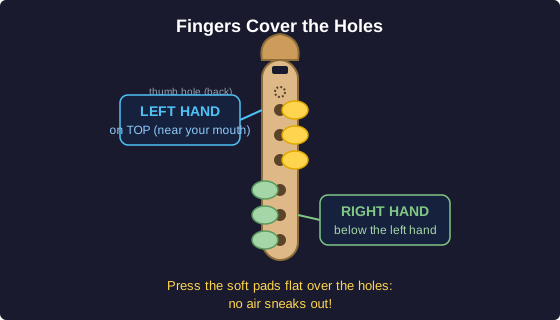
A recorder has little holes along the front. Your fingers cover the holes, like putting tiny lids on tiny cups.
Your left hand goes on top (closest to your mouth). Your right hand goes below. You press the soft pads of your fingers flat over the holes so no air sneaks out.
Practice now with no recorder: hold up your left hand and pretend you are covering three little holes with your three middle fingers. Press them down nice and flat. Now wiggle them up and down: cover, uncover, cover, uncover.
A Sailor Went to Sea
Here is a fun music game called an echo. One person sings a little bit, and then you sing it right back, just the same. Like an echo in a big room!
There is a song called "A Sailor Went to Sea, Sea, Sea." A grown-up or a friend can sing one line, and you echo it back: A sailor went to sea, sea, sea... to see what he could see, see, see...
When you learn the recorder, you will play echo games too: your teacher plays a little tune, and you play it right back. That is how musicians learn songs!
Real musicians always learn the tune first by singing it. So before you ever play a song on the recorder, you sing it. Let us try one!
Hot Cross Buns
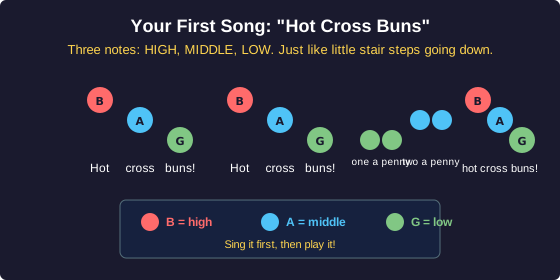
The very first song most people play on the recorder is "Hot Cross Buns." It only uses three notes, so it is easy to learn!
Here are the words. Sing them with me, going down a little stair step on "hot - cross - buns":
Hot cross buns! Hot cross buns! One a penny, two a penny, hot cross buns!
When you play it on the recorder, three notes go: high, middle, low: high, middle, low. Just like the words. You will learn it soon!
Other first songs you will play: "Mary Had a Little Lamb" (also just three notes!), and big famous tunes like "Ode to Joy" by Beethoven. The recorder lets you play all of them.
One Little Instrument, Many Big Ones
Here is something wonderful. The recorder is a little instrument, but it is a key that opens doors to many big instruments!
When you can play the recorder, you can learn the flute more easily. And the clarinet. And the saxophone. They all work the same way: you blow air, you cover holes or press buttons, and you read the music. The recorder teaches you all of that first.
And there are more instruments waiting for you: drums and xylophones and bells, a piano, a guitar. So many! But a lot of musicians start right where you are starting: with the recorder.
You are not just learning the recorder. You are becoming a musician.
You Are Ready!
Wow, you did such a great job today!
You learned about high and low, loud and soft, the steady beat, gentle warm air, wiggling your fingers, and you even sang "Hot Cross Buns." You are getting ready to be a recorder player!
Keep clapping beats, keep singing songs, and keep blowing gentle warm air. The recorder is waiting for you.