Welcome
Welcome! Today we will think about tools.
A tool is anything that helps you do a job. A spoon helps you eat. A broom helps you sweep. Some tools are helpers on a screen: a calculator adds numbers, a map app finds the way, a spell helper checks your words.
Tools are wonderful. But a good thinker knows a secret: a tool can be wrong, and some jobs you should still do yourself. Let us learn how to use tools wisely!
Tools Help Us Do More
Tools Make Us Faster
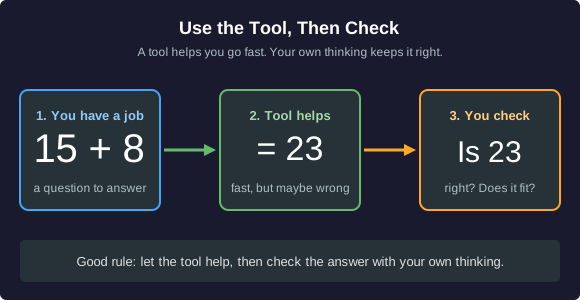
A tool helps you do more, and do it faster:
- A calculator adds big numbers in a blink.
- A map app shows you the way to Grandma's house.
- A spell helper underlines a word you spelled wrong.
- A washing machine cleans your clothes while you play.
Without these helpers, the same jobs would take much longer. That is why tools are so useful!
Your Turn
Your Turn
Think about a helper you have used, like a calculator, a map app, or a machine at home.
A Tool Can Be Wrong
Always Check!
A tool is fast, but a tool does not always understand what you meant. A tool can give a wrong answer.
Here are some ways a tool can be wrong:
- You press 15 + 8 but your finger slips and hits 15 + 80. The calculator says 95. That is not the answer you wanted!
- A map app might send you down a road that is closed.
- A spell helper might change "there" to "their" when you did not mean it to.
So here is the rule: after a tool gives an answer, stop and check it with your own thinking. Ask, "Does this answer make sense?"
Your Turn
Your Turn
You want to add 15 + 8. The right answer is 23. But your calculator shows 95 because a wrong button got pressed.
Some Jobs Keep You Sharp
Do Some Jobs Yourself
Tools are great helpers. But if a tool does every job for you, your own brain does not get to practice.
Think about it:
- If a calculator adds every number, you never learn to add in your head.
- If a spell helper fixes every word, you never learn to spell.
- If a map app always leads you, you never learn your own neighborhood.
Your brain is like a muscle: it gets stronger when you use it. So for jobs like small sums, spelling your name, or tying your shoes, it is good to practice yourself. Save the tool for the big, hard jobs.
Your Turn
Your Turn
Think about learning to add small numbers, like 2 + 3.
Help, Then Check
Putting It All Together
You have learned three big ideas about using tools wisely:
- 1. Tools help. They let you do more, faster.
- 2. Tools can be wrong. So you always check the answer with your own thinking.
- 3. Some jobs you do yourself. That keeps your brain sharp and helps you learn.
Here is a good rule to remember: Use the tool to help, then check with your own thinking. The tool is a helper. You are the boss.
Your Turn
Your Turn
A friend says, "I never check my calculator. Whatever it says must be right!"