English· Español· Deutsch· Nederlands· Français· 日本語· ქართული· 繁體中文· 简体中文· Português· Русский· العربية· हिन्दी· Italiano· 한국어· Polski· Svenska· Türkçe· Українська· Tiếng Việt· Bahasa Indonesia

nu

ゲスト
1 / ?
レッスン一覧に戻る

The Scarce Skill

The Art of the Question

For most of history, the hard part of knowledge work was producing the answer: doing the calculation, writing the draft, digging up the fact. That part is getting cheap and fast. Data, search, and automated systems now generate plausible answers on demand.

So the bottleneck moves. When answers are cheap, the scarce, high-value skill becomes framing the right problem and asking the right question: of people, of data, and of automated systems. A vague question wastes even a perfect answering engine. A sharp question multiplies it.

This lesson trains five moves that separate a good question from a lazy one:

1. Surface hidden assumptions: notice what a question quietly takes for granted.

2. Define decisive evidence: say what would settle it, or change your mind.

3. Decompose: break a hard problem into a tree of answerable sub-questions with dependencies.

4. State requirements: name what a good answer must contain before you go hunting for it.

5. Reframe: see that the same situation, asked two ways, yields two different answers, and that choosing the frame is a form of power.

A Question You Were Handed

Before we start, one reflection.

Think of a time you were handed a question or task that felt like the *wrong* question, one that missed the real issue. What was actually being asked, and what should have been asked instead? If none comes to mind, describe any question you think people frame badly.

The Question That Smuggles an Answer

A Question Can Contain Its Own Answer

The classic example: "Have you stopped cheating on tests?" There is no safe answer. "Yes" admits you used to cheat. "No" admits you still do. The question presupposes that you were cheating. That presupposition was never argued for. It was smuggled in.

This is a loaded question (also called a complex or leading question): it embeds an assumption as if it were already settled, then forces you to answer around it. The assumption rides in for free, unexamined.

Loaded framing hides everywhere, not just in trick questions:

- "How do we cut the marketing budget?" presupposes the budget should be cut, and that marketing is the problem.

- "Which competitor should we copy?" presupposes copying a competitor is the right strategy at all.

- "Why is this generation so lazy?" presupposes the generation is lazy, before any evidence.

The defense is simple and powerful. Before answering a question, ask what it assumes. Name the smuggled claim out loud. Then decide whether that claim deserves to be granted, or whether it should be the real question.

Spot the Hidden Assumption

Your Turn

A manager asks the team:

"What is the fastest way to get customers to stop complaining about our support line?"

What hidden assumption does this question smuggle in, and why is that assumption a problem? Then reframe it as a better, more honest question.

Defining Decisive Evidence

The Question Behind Every Real Question

A question you cannot imagine an answer to is not a real question yet. So before investigating anything, ask: what evidence would settle this? And its sharper cousin: what would change my mind?

If nothing could change your mind, you are not asking a question, you are defending a conclusion. Naming your decisive evidence in advance does two things. It keeps you honest, because you committed to it before you saw the result. And it tells you what to go measure, which is usually the fastest path to an answer.

A strong question comes with its own test attached: "I believe X. I would abandon X if I saw Y." If you cannot fill in Y, the belief is not yet testable, and neither is the question.

Consider this claim: *"Our new website design is better than the old one."* State exactly what evidence would settle whether it is true, AND state what specific result would make you conclude the new design is actually WORSE. Be concrete.

Breaking a Hard Question into a Tree

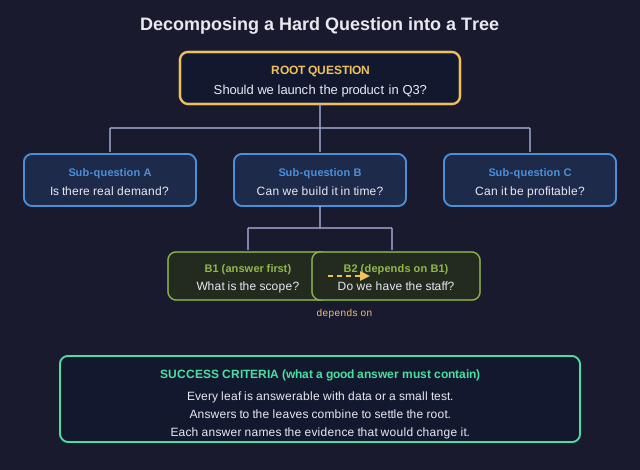
A hard root question decomposed into a tree of sub-questions with a dependency and success criteria

From One Hard Question to Many Answerable Ones

A big question like "Should we launch the product in Q3?" cannot be answered directly. It is too large. The move is decomposition: break it into sub-questions, each smaller and more answerable, until you reach questions you can settle with data or a quick test.

The sub-questions form a tree. The root is the decision. The branches are the pieces it depends on: Is there real demand? Can we build it in time? Can it be profitable? Some branches split again. And some sub-questions have dependencies: you cannot answer "do we have enough staff?" until you have answered "what is the scope?" Order matters. Answer the questions others depend on first.

Good decomposition has two properties. The sub-questions are each answerable (a leaf you can actually settle), and together they are sufficient (answer them all and the root is settled). Miss a branch and your answer has a hole.

Decompose a Messy Problem

Your Turn: Decompose It

Here is a messy, real problem a student club faces:

"Our robotics club is losing members. Should we change how we run it?"

Do not answer whether they should change. Instead, break this into a structured set of sub-questions the club would need to answer first, note at least one dependency (which sub-question must be answered before another), and state at least one success criterion: what a good answer to the whole problem must contain.

Decompose the robotics-club problem into sub-questions, name at least one dependency between them, and state at least one success criterion for a good final answer.

Same Situation, Two Questions, Two Answers

Choosing the Frame Is a Form of Power

The same situation, asked two different ways, produces two different answers, and often two different feelings about what to do.

- "How do we cut costs?" versus "How do we increase value per dollar?" Same budget, but the first hunts for things to remove and the second hunts for things to improve. They lead to opposite plans.

- A medical treatment described as "90% survive" versus "10% die" is identical in fact, yet people choose differently depending on which frame they hear. This is called a framing effect.

Whoever chooses the frame has already tilted the answer before anyone reasons. That is real power, and it is usually invisible. The defense, and the skill, is to notice the frame and try at least one other. Ask the same situation a second way on purpose. If the two framings disagree, you have found something important that the first question hid.

A school announces: *"We are removing the late-work penalty."* Give TWO different questions someone could ask about this same change that would lead to different conclusions, and explain how the framing tilts each answer.

What Will You Ask Better?

One Last Thought

Answers are getting cheaper every year. The question is not. Framing the right problem, spotting the assumption smuggled into a question, naming the evidence that would change your mind, decomposing the impossible into the answerable, and noticing who chose the frame: these are the moves that no automated system will hand you, because they decide what the system is even pointed at.

The person who asks the sharp question directs the work of everyone and everything answering it. That is the scarce skill now.

In one or two sentences, which of the five moves (assumptions, decisive evidence, decomposition, requirements, reframing) will you actually use, and where?