Welcome
Service is one of the oldest civic skills. The mechanics of how to do it well — identify, design, execute, measure, reflect — show up in nonprofits, in startups, in policy, in mutual aid.
This lesson walks you through designing a real service project of your own. Not a hypothetical one — one you could actually start this month.
By the end you will have an outline you could hand to a teacher, a parent, or a community partner.
Let's start.
Warm-Up
Let's Start!
Most of us have witnessed or participated in some kind of service project.
Specific Beats Big
Local + Concrete = Workable
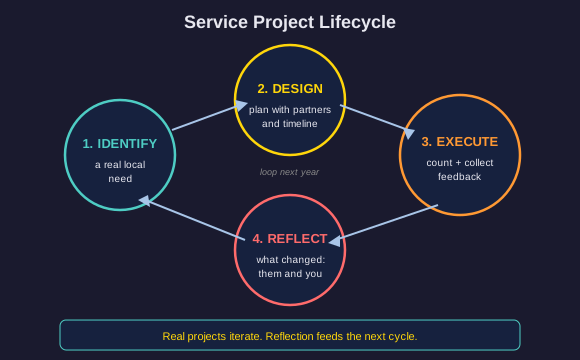
The first move in any service project is identifying a real need. This is also where most projects fail — they pick a need that's too big to actually address.
Specific beats big. A workable need has two pieces:
1. A specific group of people OR a specific place — third graders at one school, elderly neighbors on one block, the public library, a park near home, a particular food pantry
2. A concrete unmet need — no rides to medical appointments, gaps in tutoring resources, broken playground equipment, low book stock, food coverage gaps
Verify the need with a real conversation. Don't design from an assumption. Call the library, visit the senior center, talk to the food bank coordinator.
'Help the homeless' isn't a project. 'Deliver 30 weatherproof blankets to the cold-weather shelter on Main St before December 1' is.
Define Your Need
Think about your community. Pick something you can actually reach.
Project Mechanics
What Goes in a Plan
A workable plan has at least four pieces:
1. Concrete activities — what will actually happen, step by step
2. Partners or adult sponsor — who else is involved (teacher, community org, parent advisor)
3. Materials or resources — supplies, space, transportation, funding
4. Timeline — how long, how many sessions, key milestone dates
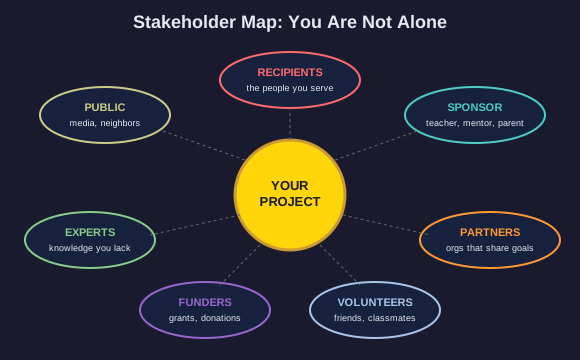
Stakeholders matter. You are not alone. Recipients, sponsors, partners, volunteers, funders, experts, and the broader public all touch a real project.
Realistic scope matters more than ambition. A small project completed beats a huge plan that stalls. You can always grow phase 2.
Build a backup plan for the most likely failure mode: what if a partner cancels? What if turnout is low? What if a venue falls through?
Sketch Your Plan
Take the need you identified in the last section.
Numbers AND Voices
Honest Measurement
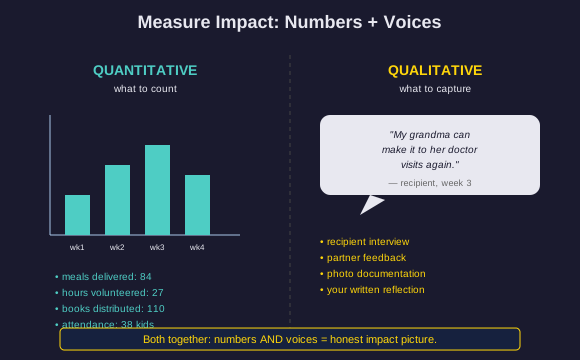
The honest answer to 'did this help?' requires two kinds of evidence:
Quantitative — things you count:
- meals delivered, hours volunteered, books distributed, attendance, dollars raised, square feet cleaned, kids tutored
Qualitative — things people say:
- recipient interview, partner feedback, photo documentation, written reflections
Numbers without voices is a billing report. Voices without numbers is a vibes report. Together they tell the real story.
Funders and college applications both reward students who can quantify impact AND share the human story. Both.
How Will You Measure?
Your project ships. People show up. Work gets done. Now — did it help?
The Two-Way Exchange
Service Changes the Giver
The best service work shifts the giver as much as it helps the receiver. Watch for that shift.
Surface reflection sounds like: 'I felt good helping people.' Real but shallow.
Deep reflection sounds like: 'I learned that the seniors I drove to appointments had been organizers in the 1960s civil rights movement. I assumed they needed me. Turns out I needed them.'
Savior framing ('I helped THEM') is a trap. It positions you above the people you serve. The more accurate frame is two-way exchange — you both change.
Ask yourself: what skill will I build? What perspective will I gain? What assumption will I test? What relationship will I deepen?
What Will Change in You?
Your project happens. You finish it. You walk away different.
One Action, This Week
Action Beats Intention
You have a need, a plan, a measurement strategy, and a sense of what will change in you.
Now the only thing left is to start. The first step doesn't have to be the project itself — just one phone call, one email, one visit.
Pick the single next action you can take in the next seven days.