Hello, Musician!
Hi there! Today you are going to learn the recorder.
A recorder is a small wind instrument. You blow air into one end, and you cover little holes with your fingers. Different fingers covering different holes make different notes.
It is light, it is friendly, and it is the instrument a LOT of musicians start with. By the end of this lesson you will play your first three notes and your first song.
How to Hold It
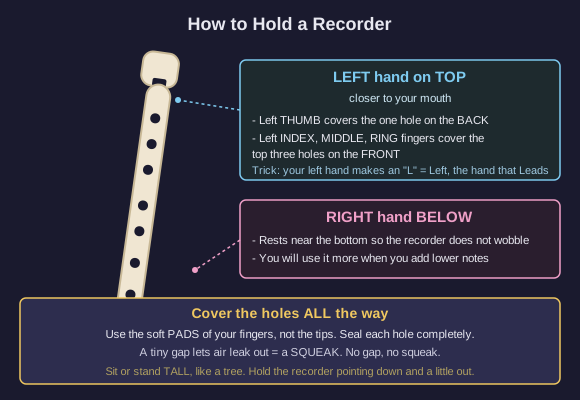
Left hand on top, right hand below
Your left hand goes on top, closer to your mouth. Your left thumb reaches around the back and covers the one hole on the back of the recorder. Your left index, middle, and ring fingers cover the top three holes on the front.
Your right hand goes below, near the bottom. We will use it more soon. For now, just rest it there so the recorder does not wobble.
Sit or stand tall, like a tree. Hold the recorder so it points down and a little out, not straight down and not straight forward.
Cover the holes ALL the way
Use the soft pads of your fingers, not the tips. Press just enough to seal each hole completely. A tiny gap lets air leak out and you get a squeak. No gap, no squeak. Lift your fingers, look at them: do you see a little ring pressed into each fingertip? That means you sealed the hole.
Warm Air, Not Hard Air
Blow like you are warming your hands
Here is the secret to a beautiful recorder sound: blow gently.
Pretend it is a cold day and your hands are freezing. You cup your hands and breathe slow, warm air on them: haaa. That is exactly how you blow into a recorder. Slow. Warm. Soft.
Do NOT blow hard, like you are blowing out birthday candles. Hard, fast air makes the recorder squeak and screech. Gentle, warm air makes it sing.
If your note squeaks, the fix is almost always one of two things: a finger is not sealing a hole all the way, or you are blowing too hard. Check your fingers, then breathe softer.
Start Every Note With Doo
Whisper doo into the recorder
When you start a note, do not just slide air in. Instead, whisper a soft doo (or too) into the recorder. Your tongue taps the roof of your mouth, just behind your teeth, then lets the air go: doo.
This is called tonguing. It gives every note a clean, clear beginning, like the first letter of a word. Without it, notes blur together and slide around.
Try it without the recorder first: say doo, doo, doo. Feel your tongue tap each time? Now do that same gentle tap into the recorder for every single note.
So the full recipe for one good note is: cover the right holes all the way, then whisper doo with slow warm air.
B, A, and G
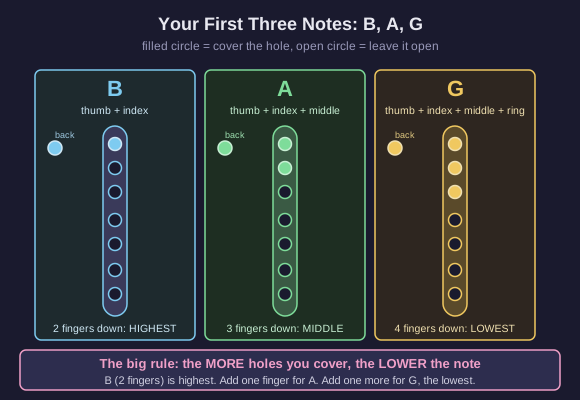
Three notes to start: B, A, G
B: left thumb on the back hole, plus your left index finger on the top front hole. Just those two. Whisper doo. That is B.
A: keep B's fingers down, and add your left middle finger. So now three fingers are working: thumb, index, middle. Whisper doo. That is A.
G: keep A's fingers down, and add your left ring finger. Now four fingers: thumb, index, middle, ring. Whisper doo. That is G.
The big rule
Notice the pattern: the more holes you cover, the lower the note. B has the fewest fingers down and is the highest. G has the most fingers down and is the lowest. Cover more = go lower. Uncover = go higher.
Practice going B... A... G... A... B, slow and gentle. Add one finger, take one finger off. Listen to the note step down, then step back up.
Your First Song
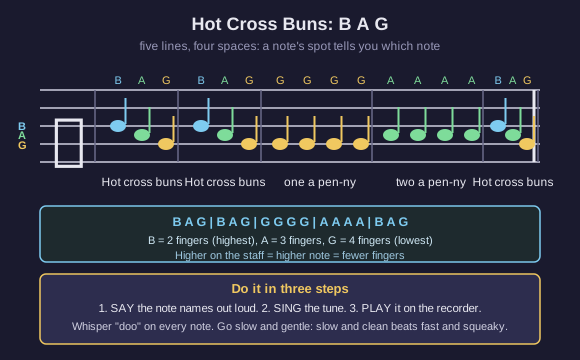
Hot Cross Buns
This song uses only your three notes: B, A, G. Here is how it goes:
- B A G (these are the words: Hot cross buns)
- B A G (Hot cross buns)
- G G G G (one a pen-ny)
- A A A A (two a pen-ny)
- B A G (Hot cross buns)
Do it in three steps
1. Say the note names out loud: B, A, G, B, A, G, G, G, G, G, A, A, A, A, B, A, G. Just speak them.
2. Sing the tune. You know it! Hum or sing Hot Cross Buns the way you have heard it.
3. Play it on the recorder. Slow and gentle. Whisper doo on every note. If it squeaks, check your fingers and breathe softer.
It is okay to go slow. Slow and clean beats fast and squeaky every time.
Same Notes, New Order
Mary Had a Little Lamb
Here is the cool part: this song uses the same three notes, B, A, and G. Just in a new order. Once you learn three notes, you do not get one song, you get many.
Here is how it goes:
- B A G A (Ma-ry had a)
- B B B (lit-tle lamb)
- A A A (lit-tle lamb)
- B B B (lit-tle lamb)
- B A G A (Ma-ry had a)
- B B B B (lit-tle lamb its)
- A A B A (fleece was white as)
- G (snow)
Same three notes. New tune. Say it, sing it, then play it: slow and gentle, doo on every note.
The Staff and Note Lengths
Five lines, where notes live
Written music sits on a staff: five lines with four spaces between them. A note's place on the staff, which line or which space, tells you which note it is, and that tells your fingers which holes to cover.
On your recorder staff: G sits low (on the second line from the bottom), A sits in the space just above it, and B sits a little higher (on the middle line). Higher on the staff, higher the note: just like the higher notes use fewer fingers.
How long to hold a note
Notes also have a shape that tells you how long to hold them:
- A quarter note is a filled-in dot with a stem. Hold it for 1 beat. Most of Hot Cross Buns is quarter notes.
- A half note is an open (hollow) dot with a stem. Hold it for 2 beats: twice as long. Words like the long held lamb or snow at the end of a line are often half notes.
So a note tells you two things: which spot it is on means which finger pattern, and what shape it is means how long to hold it.
Two More Notes, Many More Songs
After B, A, G come C and D
Once B, A, and G feel comfortable, the next notes most recorder players learn are C and D. They use different finger patterns: a fingering chart (a picture that shows filled and open circles for each note) shows you exactly which holes to cover, and your teacher can show you too. Do not worry about memorizing them yet: just know they come next.
Look how many songs five notes can play
With just B, A, G, C, and D you can already play dozens of tunes. A few you might know:
- Jack and Jill (the nursery rhyme tune: Jack and Jill went up the hill)
- There's a Hole in My Bucket (dear Liza, dear Liza)
- A Sailor Went to Sea (a fun echo song: you play a line, a friend plays it right back to you, like a musical mirror)
- Ode to Joy (a famous melody by Beethoven, from his Ninth Symphony: a tune people have loved for over two hundred years, and yes, you can play it on a recorder once you have a few more notes)
Every new note you learn opens up more songs. Three notes gave you two songs. Five notes give you dozens. That is how it grows.
You Are a Musician Now
The big idea
Here is something important, and it is true: once you can read music and make notes with your air and your fingers, you are not just a recorder player. You are a musician.
The flute, the clarinet, and the saxophone all work the same basic way as your recorder: blow air, cover holes (or press keys, which are just holes you cover with a little metal lever instead of a fingertip), and read the music. Same idea, bigger instrument.
So the recorder is your first instrument, the on-ramp. It directly unlocks the whole woodwind family. A kid who plays recorder well walks into flute, clarinet, or saxophone class and learns fast, because the reading, the rhythm, and the breathing already transfer. The only new part is the mouthpiece.
The recorder does not replace those instruments. It opens the door to them.
And later there will be plenty more doors: a piano class, a guitar class, drums, xylophone, bells. But recorder is where a lot of musicians get their start, and now it is where you are getting yours.
You Did It!
You learned how to hold a recorder, how to blow gentle warm air, how to whisper doo, and your first three notes: B, A, and G.
You can play Hot Cross Buns and Mary Had a Little Lamb. You know what a staff is and what a note's shape means. And you know the recorder opens the door to the flute, the clarinet, and the saxophone.
Keep practicing slow and gentle. A little bit every day beats a lot once in a while. You are a musician now.