English· Español· Deutsch· Nederlands· Français· 日本語· ქართული· 繁體中文· 简体中文· Português· Русский· العربية· हिन्दी· Italiano· 한국어· Polski· Svenska· Türkçe· Українська· Tiếng Việt· Bahasa Indonesia

nu

ゲスト
1 / ?
レッスン一覧に戻る

Welcome

Asking to Find Out

Every day you wonder about things. Why is the sky blue? Where did my shoe go? What is for lunch? A question is how you find out.


Some questions work better than others. A clear question tells the other person exactly what you want to know. A fuzzy question is so blurry that nobody knows how to answer it.


In this lesson you will learn four tricks that turn fuzzy wonderings into clear questions that help you find out.

Clear or Fuzzy?

Make It Clear

Imagine you walk up to a friend and ask, "What about the dog?" Your friend has no idea what you mean. That question is fuzzy.


Now imagine you ask, "What is your dog's name?" Your friend knows exactly what to say. That question is clear.


A clear question names the one thing you want to know. Here is a fuzzy question:

- Fuzzy: "What about the park?"

- Clear: "What time does the park close?"

Here is a fuzzy question a kid asked their teacher, "What about the trip?" Change it into one clear question. What clear question would you ask instead?

Ask One Thing at a Time

One Thing at a Time

When you ask too many things at once, they get tangled up and hard to answer. It is like handing someone a big knot.


Here is a tangled question, "Where are we going and when do we leave and can I bring my bike and what is for lunch?" That is FOUR questions squished into one!


It works much better to ask them one at a time. Ask "Where are we going?" first. Wait for the answer. Then ask your next question.


One question, one answer. That way nothing gets lost.

Untangle the Question

Your Turn

Here is a tangled question, "What is your favorite animal and where does it live and what does it eat?"

That question has too many parts. Pick just ONE part and ask it as a single clear question.

Open Questions and Yes-No Questions

Open Questions Get More

Some questions can only be answered "yes" or "no". "Do you like recess?" gets just a yes or a no. Those are yes-no questions.


Open questions open the door wider. They start with words like what, why, and how, and they invite a longer answer.


Look at the difference:

- Yes-no: "Do you like recess?" -> "Yes."

- Open: "What do you like about recess?" -> "I love the swings and playing tag with Sam!"


When you want to find out a lot, ask an open question with what, why, or how.

Open It Up

Your Turn

Here is a yes-no question, "Did you have a good day?" It only gets a yes or a no.

Turn "Did you have a good day?" into an open question that starts with what, why, or how, so it invites a longer answer.

Big Wonderings, Small Questions

Break It Down

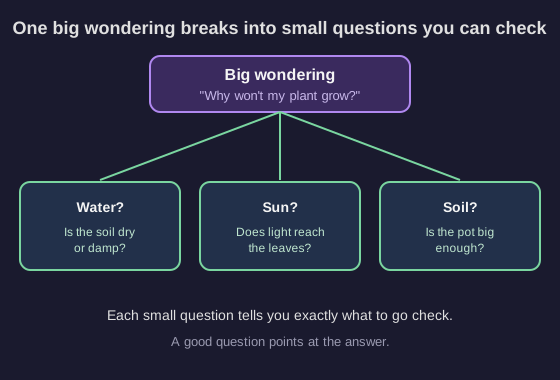
Some wonderings are very big. "Why won't my plant grow?" is a big question. It is hard to answer all at once because there are many possible reasons.


One big question splits into small checkable questions


The trick is to break the big wondering into small questions you can check, one at a time.


- Is it getting enough water? (Check if the soil is dry.)

- Is it getting enough sun? (Check if light reaches the leaves.)

- Does it have the right soil? (Check if the pot is big enough.)


Each small question tells you exactly what to go check. That is what a good question does, it points you at the answer.

Split the Big Question

Your Turn

Here is a big wondering, "Why is my bike hard to ride?"

Break that big question into ONE smaller question you could actually check, like something about the tires, the chain, or the brakes.