Welcome
How Do You Know That Is True?
Every day you meet claims. A website says a food is healthy. An app gives you a price. A search result answers your homework. A friend forwards a shocking headline. A review says a game is amazing.
Some of those claims are true. Some are wrong, out of date, or slanted to sell you something. The trick is that a wrong answer can sound just as confident as a right one.
This lesson gives you four tools to check any claim, no matter where it came from: weigh the evidence, check the source, watch for the correlation trap, and verify before you share.
The skill is simple to say and takes practice to use. Do not judge a claim by how sure it sounds. Judge it by the evidence behind it and the source it came from.
A Claim You Met
Let's start with your own experience.
Strong vs Weak Evidence
Evidence: The Reason to Believe
Evidence is the reason a claim might be true. A claim with no evidence is just an opinion wearing a costume.
Not all evidence carries the same weight. Compare these two:
- Weak evidence: one person's story, a single review, a feeling, a picture with no source, or 'everyone knows it.' It might be true, but one example proves very little.
- Strong evidence: many careful measurements, a study others have repeated, several records that agree, or data you can trace back to who collected it and how.
Ask two questions about any evidence: How much is there? and How carefully was it gathered? One loud story is weak. Many careful, repeatable measurements are strong.
Example. Claim: 'This vitamin cures colds.' Weak support: one person online says it worked for them. Strong support: a large trial where some people got the vitamin, some got a fake pill, and neither group knew which they had.
Weigh the Evidence
Your Turn
A video claims a new energy drink makes people run faster. Two kinds of support are offered:
- A: One athlete says 'I drank it and set my personal record.'
- B: A test where 200 runners were timed with the drink and without it, and the times were compared.
Primary, Secondary, and Independent
The Source: Who Is Telling You
A source is where a claim comes from. Before you trust a claim, ask where it started.
- A primary source is the original: the actual study, the eyewitness, the raw records, the person who was there.
- A secondary source describes or repeats a primary source: a news article about a study, a post summarizing a report, an app pulling numbers from somewhere else.
Secondary sources are useful, but each retelling can add a mistake or a slant. When a claim really matters, trace it back toward the primary source.
Check More Than One Independent Source
Independent sources are ones that did not copy each other. Ten websites that all copied the same post are not ten sources: they are one source repeated ten times.
Real confirmation is when separate people, who gathered their own information, arrive at the same answer. Also ask: does this source have a reason to slant the claim? A store's own page has a reason to say its product is best.
Which Source Do You Trust
Your Turn
You want to know if a phone's battery really lasts 20 hours. Two sources make claims:
- Source 1: The phone maker's own advertisement says '20 hours!'
- Source 2: A review site that bought the phone, ran the same battery test on many phones, and published its method, matching results from two other independent testers.
Together Is Not Because
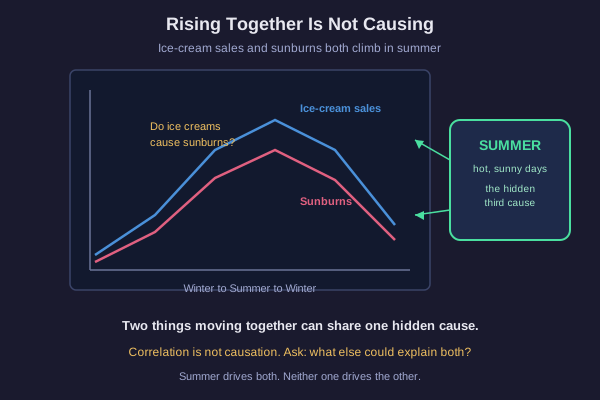
Two Things Rising Together
Here is one of the most common ways to be fooled. When two things happen together, it is tempting to say one caused the other. Often, neither did.
Look at the picture. In summer, ice-cream sales go up. In summer, sunburns also go up. They rise and fall together. Does eating ice cream cause sunburns? Of course not.
Both are caused by a hidden third thing: summer. Hot, sunny days send people out to buy ice cream and also out into the sun where they burn. Summer drives both. Neither one drives the other.
When two things move together, that is called a correlation. A correlation is a clue worth noticing, but it is not proof that one caused the other. Always ask: what else could explain both? A hidden cause, or plain coincidence, is often the real answer.
Spot the Real Cause
Your Turn
A study finds that towns with more firefighters also have more fire damage. Someone concludes: 'Firefighters cause fire damage, so we should hire fewer of them.'
Verify a Surprising Claim
The Louder the Surprise, the Harder You Check
Surprising claims spread fastest, and surprising claims are also the most likely to be wrong, exaggerated, or out of date. Before you believe or forward a shocking claim, slow down and run it through your tools.
A quick checklist for any surprising claim:
1. What is the evidence? Is there real support, or just a confident voice?
2. Where did it come from? Trace it toward the original source, not the tenth person who repeated it.
3. Does more than one independent source agree? Or is it the same claim copied around?
4. Is it current? Old numbers and old prices go stale.
This applies to every source: a search result, an app, a review, an automated answer, a headline, a friend. None of them get a free pass just because they sound sure.
Your Verification Plan
Your Turn
You see a post claiming: 'Scientists say chocolate is now proven to make you 30% smarter.' It is surprising, it has no link, and it is being shared fast.