A Whole Family
Most people meet the recorder once, in elementary school, as a single plastic soprano. That instrument hides a secret: the recorder is not one instrument, it is a whole family.
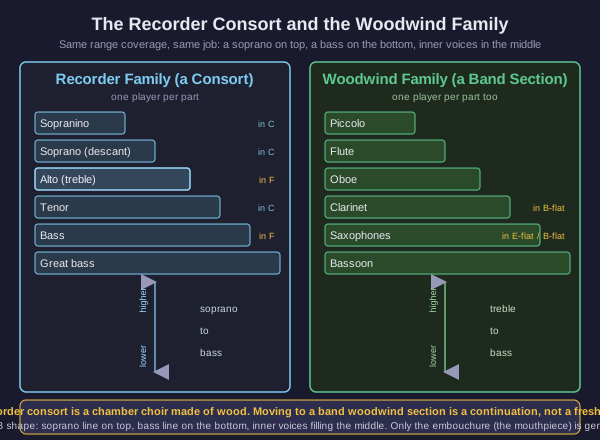
From highest to lowest: sopranino, soprano (also called descant, pitched in C), alto (also called treble, pitched in F), tenor (in C), bass (in F), and great bass. Together they cover the same span a choir covers, soprano down to bass.
A recorder consort is an ensemble of these instruments, one player per part, the way a string quartet has one player per part. Renaissance and Baroque households owned consorts and played four-part and five-part music around a table.
Hold that picture, because it maps directly onto the woodwind family of a concert band: piccolo, flute, oboe, clarinet, the saxophones, bassoon. Same idea, same range coverage, same job: a soprano voice on top, a bass voice on the bottom, inner voices filling the middle.
Why a Family?
Voices in a Choir
In an SATB choir, soprano, alto, tenor, and bass each sing a different line; together they make a complete chord on every beat. A recorder consort works the same way: each size of recorder plays one of those lines.
Same Fingers, Different Pitch
The Heart of the Whole Band
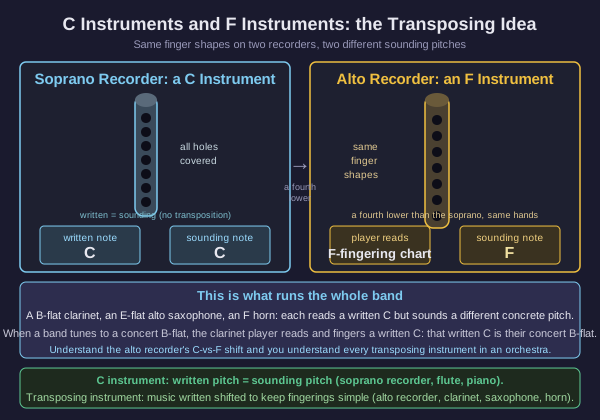
Cover every hole on a soprano recorder and the note that comes out is C. The soprano is a C instrument: what it reads on the page and what it sounds are the same pitch.
Cover every hole on an alto recorder, using the same finger shapes, and the note that comes out is F, a fourth lower. The alto is an F instrument. Alto players learn a separate fingering chart, often called F fingering, so the printed C they see lines up with the F-position shapes their hands already know.
This is the transposing instrument concept, and it runs the entire band. A B-flat clarinet, an E-flat alto saxophone, an F horn: each one reads a written C but sounds a different concrete pitch. When a band tunes to a concert B-flat, the clarinet player fingers and reads a C: that written C is their concert B-flat.
Here is the payoff: once you understand why the alto recorder's lowest note reads one way and sounds another, you understand every transposing instrument in an orchestra. The recorder hands you the concept early, with two cheap instruments side by side.
Explain Transposition
Following, Counting, Blending
Your Eyes Do Half the Work
Playing alone, you only manage yourself. In a consort or a band, you manage yourself and stay locked to everyone else, and most of that locking happens with your eyes.
Following the leader. Watch the conductor, or in a small consort watch whoever leads (often the top part). The beat lives in the stick or the breath of the leader, not in your foot.
Counting multi-bar rests. Your part may say rest for 12 bars. You count those bars silently and exactly: a missed count means a missed entrance. Mark big rests in your music. Glance up to confirm the conductor's count.
Cueing entrances. When your line re-enters, you come in precisely on the cue, breath ready before the beat, not a moment late or early. A conductor will often look at your section right before you play: that is your cue.
Blending. You match your section's intonation (the same in-tune pitch), tone color, and articulation (how you start and shape each note) so no single player sticks out. Blend means listening sideways: are you brighter than the player next to you? louder? sharper? Pull toward the center.
Watching, not just listening, is the habit that separates an ensemble player from a soloist who happens to be in a room with other people.
Ensemble Skills
Trills, Mordents, Appoggiaturas, Turns
The 1600s and 1700s Belonged to the Recorder
Before the transverse flute pushed it aside in the late 1700s, the recorder was a leading solo and ensemble instrument. The repertoire is enormous and central: Georg Philipp Telemann wrote recorder sonatas and the great Suite in A minor for recorder and strings; J. S. Bach scored recorders into the Brandenburg Concertos number 2 and number 4; Handel wrote recorder sonatas; Vivaldi wrote concertos for it. A serious recorder player works through this music.
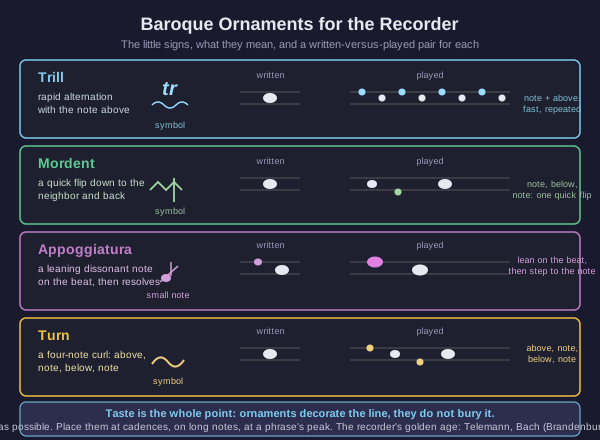
Baroque players did not play the printed notes plainly. They decorated the line, partly from written signs and partly by adding their own. The core ornaments:
- Trill: a rapid alternation between the written note and the note just above it. Often written as tr over the note.
- Mordent: a quick single flip down to the note below and back, like a tiny stumble and recovery. (An upper mordent flips up instead.)
- Appoggiatura: a leaning note, a small printed grace note that lands on the beat as a dissonance, then steps to the main note and resolves. It is the sigh in a phrase.
- Turn: a four-note curl around the written note: the note above, the note itself, the note below, the note itself. Written as a small S-on-its-side sign.
Taste Is the Whole Point
The rule for ornaments: they decorate the line, they do not bury it. Not every sign needs the maximum number of repetitions. Not every trill needs to be as fast as possible. Place them where the phrase wants to breathe: at cadences, on long notes, at the peak of a phrase. An over-ornamented line sounds nervous; a tastefully ornamented line sounds alive.
Three Ornaments
Warm Air Goes Sharp
Geometry You Can Hear
A recorder goes sharp as it warms up. Warm air travels faster, sound waves move faster, and faster waves in the same tube mean a higher pitch. A cold recorder at the start of a piece will drift up over the first minutes of playing.
To tune, you adjust the head joint: the top section with the mouthpiece.
- Pull the head joint out to flatten the pitch. A longer effective tube means a lower note.
- Push the head joint in to sharpen the pitch. A shorter tube means a higher note.
Tube length and pitch sit in an inverse relationship: lengthen the air column and the pitch falls; shorten it and the pitch rises. A small slide of the head joint is a real, audible change in pitch, so move it a little and listen.
What you tune to. Modern ensembles tune to A = 440 Hz, the standard concert pitch. Historically informed Baroque ensembles often tune lower, to A = 415 Hz, roughly a semitone below 440: that is why a Baroque recorder bought for 415 will sound out of place in a 440 band. Pick your pitch standard before you tune, not after.
Which Way Do You Move It?
In the Hall of the Mountain King
Everyone Speeds Up Together
Take Edvard Grieg's In the Hall of the Mountain King and arrange it for a recorder consort. The piece is built on one short, creeping motif that repeats, climbs, and gathers speed and volume until it explodes.
Split it into parts: one voice carries the melody (the motif itself), another weaves a counter-melody against it, and the bass line drives the relentless, stalking pulse underneath. The parts are not independent songs: they interlock. The bass tells everyone where the beat is; the counter-melody answers the motif; the melody sits on top and stays clear.
The hard part is the accelerando and crescendo: the music must get faster and louder, and that has to be coordinated across the whole consort. If one player speeds up alone, the piece falls apart. So everyone watches the section leader (or conductor), who sets and pushes the tempo: eyes up, breathe together, accelerate together. The crescendo works the same way: the section grows as one, not as a race between players.
The same skill applies to real Baroque repertoire in parts: a movement from a Telemann suite or a Bach Brandenburg has independent lines that must lock rhythmically and balance dynamically, with one player (or the harpsichord, or the conductor) holding the tempo. Whether it is Grieg arranged for fun or Bach played straight, the discipline is identical: read your line, lock to the pulse, follow the leader, blend.
Locking the Parts Together
Leading a School Recorder Group
Being the One Others Watch
In a school recorder group or a band section, a section leader is the most experienced player whose job is to make everyone around them better.
- Help the younger players. Sit beside a struggling player, slow a passage down, walk them through a fingering, model the breath.
- Model good tone and tuning. The section copies the leader without being told. If the leader plays with a clear, centered tone and tunes carefully, the section drifts toward that. If the leader is sloppy, so is the section.
- Mark the parts. Pencil in breath marks so everyone breathes in the same place, write in dynamics the conductor asked for, circle tricky entrances and big rests, number the bars. A well marked part plays itself under pressure.
- Run a quick sectional. Pull the section aside for a few minutes to woodshed a hard passage: isolate the spot, take it slow, loop it, speed it up, put it back in context. Five focused minutes fixes what an hour of full rehearsal cannot.
Leadership here is not about being the loudest or the fastest. It is about being reliable, prepared, and generous: the player whose stand the others glance at when they are lost.
What a Section Leader Does
The Instruments Change, the Musicianship Does Not
Why the Recorder Is Worth It
Here is the claim this whole lesson has been building toward: playing in a recorder consort teaches you everything you need to play in a concert band, a wind ensemble, or an orchestra's woodwind section.
Look at what you have practiced: reading your own part, following a conductor, counting multi-bar rests, cueing entrances precisely, blending intonation and tone and articulation, tuning by adjusting tube length, and handling transposing instruments (the alto recorder's C-vs-F shift). Every one of those transfers, unchanged, to a band woodwind chair. The reading is the same. The rhythm is the same. The breath support is the same. The ensemble discipline is the same.
And the families line up. The recorder family, soprano through bass, directly mirrors the woodwind family: piccolo, flute, oboe, clarinet, the saxophones, bassoon. Moving from a recorder consort to a band woodwind section is a continuation, not a fresh start. The only thing that is genuinely new on each instrument is the embouchure: the way your mouth shapes the air at the mouthpiece. A flute's lip-plate, a clarinet's single reed, an oboe's double reed, a saxophone's mouthpiece: those each take new muscle memory. Everything behind the embouchure, you already have.
So a strong recorder player can join a band program and pick up clarinet, flute, or saxophone fast, because the hard part, the musicianship, is already in place. The recorder is the on-ramp that directly unlocks saxophone class, flute, clarinet, oboe, and the consort experience is the on-ramp to every wind ensemble. Parallel on-ramps exist too: percussion and mallets and bells lead one way, piano leads another, guitar another. But for the woodwind family, the recorder is the door.
What Transfers, What Is New
What Will You Carry Forward?
One Last Thought
You have walked the recorder ladder: the consort and its family, the C-vs-F transposition that runs every band, reading and blending in an ensemble, Baroque ornamentation in the recorder's golden age, tuning by tube length, a full arrangement in parts, and section leadership. And you have seen where the ladder leads: straight into a wind ensemble's woodwind section.
The recorder gets dismissed as a children's toy. It is not. It is the on-ramp to the entire woodwind family and to ensemble playing itself. Walk through that door and the rest of the band is waiting.