Welcome
The soprano recorder (also called the descant recorder) looks simple: a tube with holes and a whistle mouthpiece. Do not let that fool you. It is one of the most demanding instruments to play well, and it teaches everything you need to walk into a band room and pick up a flute, clarinet, oboe, or saxophone.
In this lesson you will learn:
- The recorder's full diatonic range: low C up to high F.
- Cross-fingering: how to play the sharps and flats between the natural notes.
- Articulation: tonguing, slurs, staccato, accents.
- Breath and phrasing: where to breathe so a long melody still flows.
- Why dynamics on a recorder are tricky, and what good players do instead of just blowing harder.
- 'In the Hall of the Mountain King' by Edvard Grieg: how to build a long accelerando and crescendo without losing control.
- Tempo arithmetic: turning beats per minute into seconds.
- Playing with others: duets and rounds.
And the big idea at the end: the recorder is not a toy. It is the fastest on-ramp to the entire woodwind family.
Warm-Up
Before We Begin
Maybe you played recorder in elementary school. Maybe you have never touched one. Either way: think about a wind instrument you have heard up close, in person, on TV, in a movie, or in a song.
Low C to High F
The Diatonic Ladder
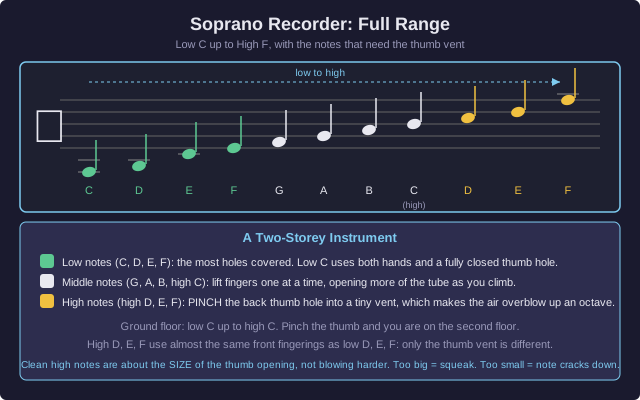
On a soprano recorder, the basic playable range covers a bit more than an octave and a half. Going up, the natural notes are:
low C, D, E, F, G, A, B, then high C, D, E, F.
Here is the pattern your fingers follow:
- Low notes (C, D, E, F) cover the most holes. Low C uses both hands and all the holes, plus the thumb hole on the back fully closed. The more tube you leave covered, the lower the pitch.
- Middle notes (G, A, B) lift fingers one at a time, opening more of the tube as you climb.
- High notes (high D, E, F) use the thumb vent: instead of fully closing the back thumb hole, you pinch it, leaving a tiny crescent of opening. That small leak makes the air column split and overblow into the upper register, jumping you up an octave. Getting a clean high note is mostly about the size of that thumb opening, not blowing harder.
Think of it as a two-storey building. Ground floor: low C to about C. Pinch the thumb and you are on the second floor: high D, E, F use almost the same fingerings as low D, E, F, just with the thumb vent open.
Why the Thumb Pinch?
Sharps and Flats Between the Notes
Filling In the Gaps
The basic fingerings give you a plain diatonic scale: the white-key notes. But music needs the in-between notes too: F#, Bb, C#, and the rest. To get them, you use cross-fingering.
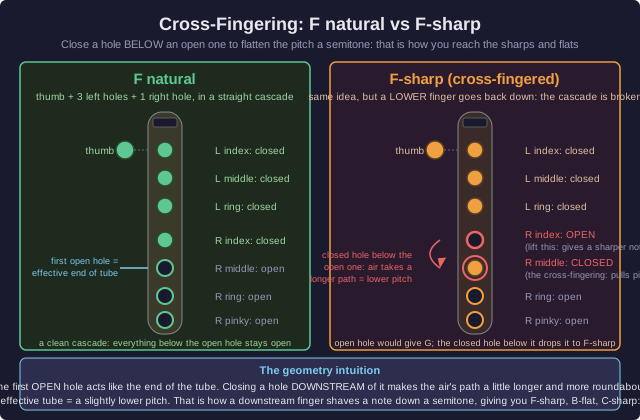
Cross-fingering means you close a hole that is below an open hole. Normally when you lift a finger to raise the pitch, every hole below it stays open. In a cross-fingering you put one of those lower fingers back down.
Why does that work? Think geometry. A recorder is a tube; the first open hole acts like the effective end of the tube. Closing a hole downstream (below the first open hole) does not fully reopen the tube, but it makes the air's path a little longer and more roundabout. A longer effective tube means a slightly lower pitch. So a downstream finger can shave a note down by a semitone.
Concrete example: F natural on a soprano recorder is thumb plus the first three left-hand holes plus one right-hand hole. F# is the same idea but you skip a hole and add a lower right-hand hole back in: the open hole gives you a sharper note, and the closed hole below it pulls it back down just enough to land on F# instead of G. Cross-fingerings feel awkward at first because your fingers are not in a straight cascade anymore, but they are how you play in any key.
What Cross-Fingering Buys You
Tonguing, Slurs, Staccato, Accents
Shaping Each Note
On a recorder you do not start a note by 'blowing'. You start it with your tongue, the same way you start a syllable. This is called tonguing or articulation, and it is half of sounding musical.
- Single tonguing: say a soft 'doo' or 'too' to start each note. 'Doo' is gentler and rounder; 'too' is crisper and more pointed. The breath keeps flowing; the tongue just interrupts it to mark where each note begins.
- Legato / slurred notes: tongue only the FIRST note, then let the rest flow without re-tonguing: 'doo-oo-oo'. In notation, a curved line (a slur) over a group of notes means 'play these in one breath, tongued only at the start.' Slurred passages sound smooth and connected.
- Staccato: short, detached notes. Say a quick 'dit' or 'tut': the tongue starts the note and almost immediately stops the air. In notation, a small dot above or below a notehead means staccato. Staccato notes sound light and bouncy.
- Accents: a note played with extra emphasis at the start: a stronger 'TOO'. In notation, a > symbol above the note means accent. Accents pop a note out of the line.
A melody played with all the same flat 'doo doo doo' sounds dull. The same melody with some notes slurred, some staccato, and a couple accented suddenly has shape and character. Articulation is punctuation for music.
Slur vs Staccato
Where to Breathe
Breathing Without Breaking the Music
A wind player cannot breathe in the middle of a thought any more than you can take a gasping breath in the middle of a sentence. So you plan.
Music is built from phrases: short musical sentences, usually two or four bars long, that feel complete on their own. A melody is a chain of phrases, the way a paragraph is a chain of sentences.
The rule: breathe at the ends of phrases, where there is a natural comma or period in the music. Breathing there is invisible: it sounds intentional. Breathing in the middle of a phrase chops the line in half and sounds like a mistake.
Practical method:
- Look through the piece before you play it. Find the phrase endings (often where a long note sits, or where the melody settles back down).
- Mark a tiny tick mark (a comma, or the symbol used for a 'breath mark') in your part at each spot where you plan to breathe.
- If a phrase is too long for one breath, find the least disruptive spot inside it: usually after a longer note or right before a leap, never in the middle of a fast run.
- Take a quick, low, quiet breath: enough air, but no loud gasp.
Good phrasing is what separates 'playing the right notes' from 'making music'. The notes are the words; the phrasing is the sentence.
Planning a Breath
Why You Can't Just Blow Louder
The Recorder's Dirty Secret
On a piano you press harder for louder. On a guitar you strum harder. On a recorder, if you blow harder the note gets sharp (the pitch rises). Blow softer and the note goes flat (the pitch drops). So 'just blow louder for forte' does not work: you would play out of tune.
Why? The recorder's pitch depends partly on air speed through the windway. More pressure means faster air means higher pitch. The instrument is built so that one specific air speed gives the in-tune note. Push past it and you go sharp.
So what do recorder players actually do to shape dynamics?
- Control air speed carefully. You can get a little louder or softer by adjusting air, but only within a narrow band before the pitch drifts. You learn that band by ear.
- Adjust the air column shape. A faster, more focused air stream from a tighter throat and faster tongue position versus a warmer, broader stream changes the quality and apparent volume more than raw pressure does.
- Use alternate fingerings. For some notes there is a second fingering that sounds at a slightly different volume or that holds pitch steady when you push more air. Players keep these in their back pocket for loud or soft passages.
- Shape phrases with articulation and timing, not just volume. A note that is accented, or slightly stretched, or crisply tongued reads as stronger even at the same dynamic.
Listen to a fine recorder player and you will hear a melody that breathes and swells: but it is done with subtle air control, articulation, and phrasing, not brute force. The recorder rewards finesse and punishes muscle.
Shaping Dynamics
Grieg's Creeping Theme
One Tiny Tune, Repeated to a Frenzy
'In the Hall of the Mountain King' is a short piece by Edvard Grieg, written in 1875 for the play Peer Gynt. You have heard it: it is the music that sounds like trolls sneaking up on you and then chasing you out.
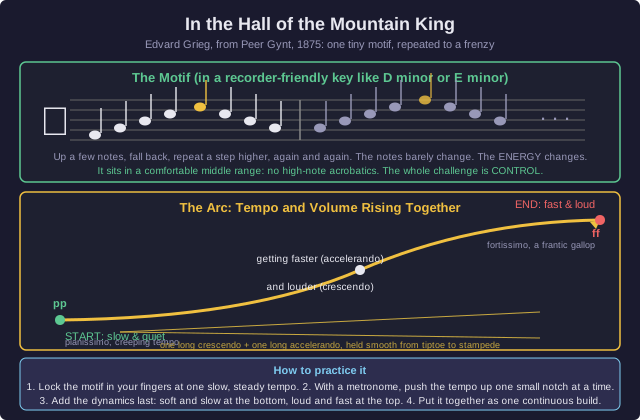
The whole piece is built from one tiny motif: a short figure that creeps up a few notes and then falls back, then does it again, a step higher, over and over. In a recorder-friendly key like D minor or E minor the motif sits in a comfortable middle range: no high-note acrobatics.
Here is the genius of it. The motif barely changes. What changes is the energy:
- It starts very slow and very soft (pianissimo, marked pp): a creeping tempo, like tiptoeing.
- It gradually speeds up (a long accelerando) and gets louder (a long crescendo).
- By the end it is a frantic, fortissimo (ff) gallop, almost out of control.
So the piece is easy: the control is the hard part. The challenge is holding a smooth, steady speed-up and a smooth swell of volume across the whole thing, without lurching.
How to Practice It
1. Lock the motif in your fingers. Play it slowly and steadily, the same comfortable tempo, until your fingers do it without thinking. Tongue each note cleanly.
2. Push the tempo a notch at a time. Use a metronome. Play the motif a few times at one speed, bump the metronome up a small amount, play it again, bump it up again. Never jump: you want the speed-up to feel like a single smooth ramp.
3. Add the dynamics last. Once tempo is solid, start the motif soft and let it grow louder as it gets faster. Soft and slow at the bottom; loud and fast at the top. Make the swell gradual, not a sudden jump.
4. Put it together and play the whole arc: from a tiptoe to a stampede, in one continuous build.
Doubling the Tempo
A Question About the Build
Suppose 'In the Hall of the Mountain King' starts at about quarter note = 80 BPM and ends at about quarter note = 160 BPM.
Turning BPM Into Seconds
The Math Behind the Metronome
Tempo is measured in beats per minute (BPM). To find out how long one beat lasts, divide 60 seconds by the BPM:
one beat (in seconds) = 60 / BPM
Worked example at quarter note = 120 BPM (so the beat is a quarter note):
- one beat (one quarter note) = 60 / 120 = 0.5 seconds
- a half note = 2 beats = 2 x 0.5 = 1 second
- a whole note = 4 beats = 4 x 0.5 = 2 seconds
- one measure of 4/4 = 4 beats = 4 x 0.5 = 2 seconds
And to find how long a stretch of music lasts:
duration = (number of bars) x (beats per bar) x (60 / BPM)
Worked example: how long is a 16-bar section in 4/4 at 100 BPM?
- one beat = 60 / 100 = 0.6 seconds
- 16 bars x 4 beats/bar = 64 beats
- 64 beats x 0.6 s/beat = 38.4 seconds
Back to the Mountain King: if it starts at quarter note = 80 BPM and ends at quarter note = 160 BPM, the tempo has doubled, so any fixed passage takes half as long at the end. A repetition that took 6 seconds at the start takes 3 seconds at the end. That is the accelerando doing its job: same notes, half the time.
Compute a Section Length
Your Turn
Use the formula: duration = (bars) x (beats per bar) x (60 / BPM).
Duets and Rounds
Two Recorders Are Better Than One
Once you can hold your own line, the next skill is playing it while someone else plays a different line. That is ensemble playing, and it is a whole new layer.
- Duet: two players, two different parts that fit together. Usually one carries the melody (the tune you would hum) and the other plays a harmony line (notes that sit underneath and support it, or a counter-melody that weaves around it). Neither part makes complete sense alone; together they make a fuller piece. A simple Bach minuet, for example, has a melody line up top and a quieter bass line moving underneath it.
- Round (canon): everyone plays the same tune, but each player starts a phrase later than the one before. Because the tune is written so its overlapping copies harmonize, it sounds like rich many-part music even though there is only one melody. 'A Sailor Went to Sea' works as a two-part round: the second player starts one phrase behind the first, and the notes still line up sweetly. So do 'Row, Row, Row Your Boat' and 'Frere Jacques'.
The new skill ensemble playing demands is counting rests. When your part is silent, you do not get to relax: you keep counting beats and bars in your head so you come back in exactly on time. Come in a beat early or late and the whole thing wobbles. Watch the other player, listen for landmarks, and count, count, count.
Playing with others also tightens everything else: your tempo has to match theirs, your tuning has to match theirs, and your phrasing has to breathe with theirs. It is the best ear training there is.
Coming In On Time
The Recorder Is the Door
Why You Just Learned All This
Look back at everything in this lesson:
- Reading notation, including key signatures and the sharps and flats in them.
- Controlling your air: speed, focus, the narrow band that keeps you in tune.
- Coordinating fingers across both hands, including awkward cross-fingerings.
- Articulation: tonguing, slurs, staccato, accents.
- Breath and phrasing: planning where to breathe so the line flows.
- Dynamics: shaping volume without wrecking pitch.
- Ensemble counting: coming in on the exact right beat after a rest.
Here is the point: that is exactly what a flute, clarinet, oboe, or saxophone player does. Same notation. Same key signatures. Same air control. Same finger coordination across both hands. Same articulation. Same breathing and phrasing. Same counting in a band.
The recorder has no reed and a simple fingering system, so it is the fastest way into all of that. A student who plays recorder well walks into band class and picks up a 'real' woodwind in weeks, not years: because the reading, the rhythm, the breath, and the finger work are already there. The one genuinely new thing is the mouthpiece: the embouchure, how you shape your lips and use your air on a flute headjoint or a reed. That is real, and it takes practice. But it is one new skill on top of a stack you already own, instead of starting from zero.
The recorder does not replace the flute, clarinet, oboe, or saxophone. It unlocks them. Saxophone class, flute, clarinet, oboe: they are all downstream of the recorder. And there are parallel on-ramps coming too: a percussion / xylophone / bells path, a piano class, a guitar class. Different doors into the same building. The recorder is the one that opens onto the entire woodwind wing.
What Transfers
Well Done
You Covered a Lot
After this lesson you can:
- Name the full range of the soprano recorder: low C up to high F, and explain the thumb vent that overblows you into the high octave.
- Explain cross-fingering: closing a hole below an open one to reach the sharps and flats, so you can play in any key.
- Describe articulation: single tonguing ('doo'/'too'), slurs (tongue the first note only), staccato (short 'dit'), and accents, and read the slur lines, staccato dots, and accent marks in notation.
- Plan your breathing: breathe at phrase ends, mark the spots with a tick, never chop a phrase in half.
- Explain why dynamics on a recorder cannot come from blowing harder (the pitch goes sharp), and what players do instead: careful air speed, air-column focus, alternate fingerings, articulation and timing.
- Describe how 'In the Hall of the Mountain King' works: one tiny motif, a long accelerando and crescendo from a tiptoe to a stampede, and how to practice it (lock the fingers, push the tempo a notch at a time, add dynamics last).
- Do tempo arithmetic: one beat = 60/BPM seconds, and a passage lasts bars x beats-per-bar x (60/BPM) seconds.
- Explain ensemble playing: melody and harmony lines in a duet, the staggered same-tune structure of a round, and counting rests so you enter on the exact right beat.
- And the big one: the recorder is the fastest on-ramp to the entire woodwind family: flute, clarinet, oboe, saxophone are all downstream of it, and the only genuinely new thing on those instruments is the embouchure.